


Hampi places to visit 2026: UNESCO Ruins, Hidden Temples & the Backpacker's Complete India Guide

Updated: Sep 28
I still remember the first time I sent a client group to Hampi back when I was newer to operations at Astamb Holidays — I under-briefed them on the heat and over-briefed them on the temples. They came back sunburnt but obsessed, asking when they could return.
That's Hampi in one sentence: it wrecks your itinerary planning and rewards you anyway.
This Hampi places to visit 2026 is built from that kind of hands-on trip planning, not a checklist copied off a search results page. It covers the UNESCO ruins, the quieter temples most tour groups skip, current ASI ticket pricing, and the practical side — trains, budgets, and where backpackers actually stay now that the old riverside cafe strip is gone.
Hampi is a UNESCO World Heritage Site in Karnataka, built around the 14th-century ruins of the Vijayanagara Empire. Carved granite temples sit scattered across a boulder-strewn landscape split by the Tungabhadra River. The southern bank holds most of the monuments; the northern bank, around Anegundi and Sanapur Lake, is where the backpacker culture now lives.
This guide is for budget travelers, history buffs, photographers, and solo wanderers planning a South India backpacker itinerary. We'll cover what to see, what it costs in 2026, how to get there, and what's actually changed on the ground.
Most first-time visitors underestimate how spread out Hampi actually is. This isn't a single compact monument complex you can tick off in an afternoon — it's a 41-square-kilometer archaeological zone, and the sites are scattered across boulder hills, riverbanks, and farmland on both sides of the Tungabhadra. Budget more time than you think you need, and build in slack for the heat.
🏛️ Why Hampi Belongs on Your India Travel Itinerary in 2026
The Landscape: Boulders, Paddy Fields, and Ancient Stone
Nothing quite prepares you for the geology. Massive granite boulders, some the size of buildings, are scattered across a landscape that looks almost staged.
Green paddy fields cut through the boulder fields in sharp contrast. Temple spires rise out of this terrain like they grew there rather than being built.
Local Insight Tip: Photographers should time boulder-field walks for early morning or late afternoon. Midday light flattens the granite and washes out the color contrast that makes Hampi's landscape photograph so well.
The Legacy of the Vijayanagara Empire
Hampi was the capital of the Vijayanagara Empire, one of the wealthiest kingdoms in South Asian history through the 14th to 16th centuries. Under rulers like Krishnadevaraya, the empire controlled trade routes stretching to Persia and Portugal.
The city fell in 1565 after the Battle of Talikota, when a coalition of Deccan sultanates defeated the Vijayanagara forces. What followed was months of systematic destruction — the ruins you see today are what survived that.
Hampi in 2026: What Has Changed for Travelers?
A few things are genuinely different from even three or four years ago. The ASI composite ticket is now standard practice, and most travelers book it online rather than queuing at the gate.
Private vehicles remain banned inside the inner protected monument zone — you'll switch to a battery-operated shuttle or walk for the last stretch near Vittala Temple. And the accommodation map has shifted permanently: the old riverside cafe cluster on Virupapur Gaddi ("Hippie Island") was demolished by court order back in 2020, and the backpacker scene has firmly relocated to Anegundi and Sanapur villages, a few kilometers further north.
In my experience planning tours at Astamb Holidays, this is the single most common source of confusion for first-time visitors — they've read old blog posts describing a cafe strip that no longer physically exists.
I usually tell clients to think of Hampi 2026 as a two-village system on the north bank rather than a single "island." Anegundi has the more established guesthouse infrastructure and easier scooter rental options, while Sanapur leans quieter, closer to the lake, and better suited to travelers who want fewer neighbors. Neither has the dense, party-hostel energy the old Hippie Island once had, and that's mostly a good thing — it's a calmer, more grounded version of the same backpacker culture.
🗺️ Hampi Geography Explained: The Sacred Center vs. The Northern Bank (Anegundi)
Understanding the two-bank layout saves a lot of confused planning later.
Zone | Major Highlights | Vibe & Accommodation Style | Best For |
South Bank (Hampi Bazaar / Sacred Center) | Virupaksha Temple, Matanga Hill, Royal Enclosure, Vittala Temple | Historic town, traditional homestays, early monument access | History buffs, early risers, culture travelers |
North Bank (Anegundi & Sanapur) | Sanapur Lake, Anjanadri Hill, coracle crossing points, boulder fields | Laid-back guesthouses, paddy-field cafes, scooter rentals | Solo backpackers, nature lovers, climbers |
A coracle or the small ferry connects the two banks near Virupaksha Temple. Most travelers base themselves on one side and day-trip to the other.
Local Insight Tip: Don't try to see both banks thoroughly in one day. I've watched clients rush the crossing, spend an hour on the north side, and miss the point of either half. Give each bank its own dedicated block of time — a full day works far better than a rushed half-day hop.
🛕 Places to visit Hampi: Must-Visit UNESCO Sites & Temples
Virupaksha Temple: The Living Heart of Hampi
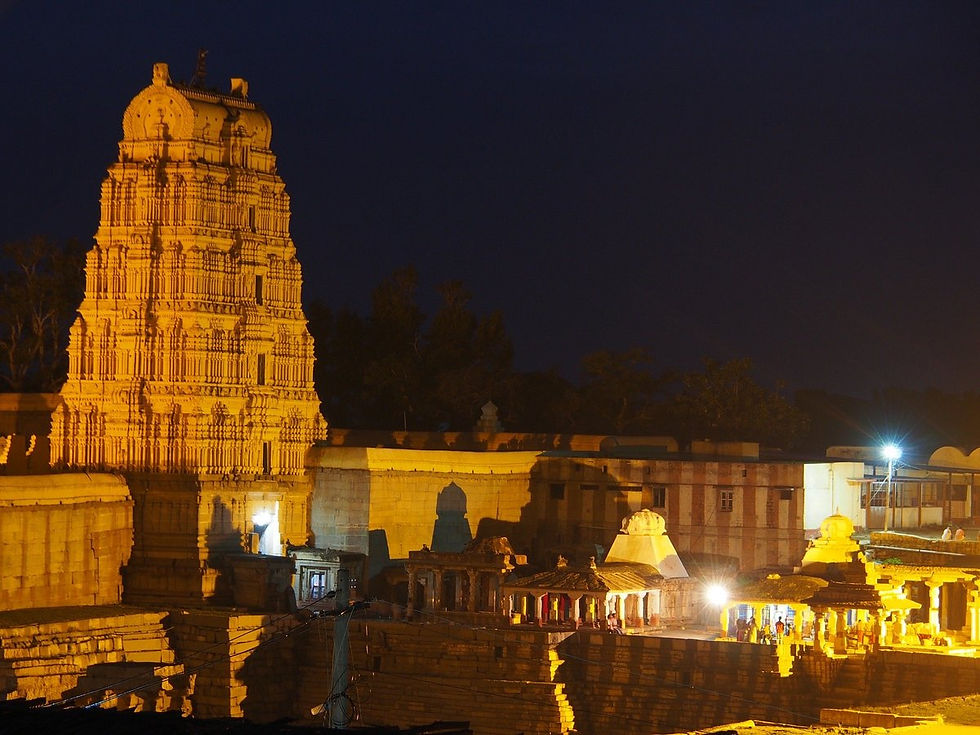
Unlike most of Hampi's ruins, Virupaksha Temple is still an active place of worship — daily rituals happen here, and it predates the Vijayanagara Empire itself. The nine-story gopuram towers over Hampi Bazaar and is visible from most of the boulder hills around town.
Arrive close to opening, around 6 AM, for quiet corridors and softer light on the carved pillars. Entry to Virupaksha Temple itself is free.
Local Insight Tip: Cover your shoulders and knees before entering. Priests occasionally turn away visitors in shorts or sleeveless tops, especially during morning rituals.

Vittala Temple & the Iconic Stone Chariot
This is the postcard image of Hampi — the Stone Chariot, carved from a single granite outcrop, sitting in front of the Vittala Temple's main mandapa. It's famous enough to appear on India's currency notes, which tells you how central it is to the country's heritage identity.
Inside, 56 carved pillars are known for producing distinct musical notes when tapped — ASI guides sometimes demonstrate this. British engineers cut into two pillars in the 19th century looking for a hidden mechanism and found only solid stone; the sound comes from granite density and pillar geometry, nothing more exotic.

The complex sits about 2 kilometers from the main road, and private vehicles aren't allowed inside. A battery-operated shuttle covers the stretch for ₹10 per person one-way, or you can walk it in about 25 minutes.
Local Insight Tip: Visit before 9 AM. Tour buses from Hospet start arriving mid-morning, and the mandapa gets genuinely crowded by 11.
Hemakuta Hill: Sunrise, Sunsets & Pre-Vijayanagara Structures
This is an easy 10-15 minute climb right behind Hampi Bazaar, dotted with a cluster of Jain and pre-Vijayanagara Hindu shrines. It's less demanding than Matanga Hill, which makes it a good option if you're short on time or energy.
The panoramic views over Hampi Bazaar and the surrounding boulder fields make it popular for both sunrise and sunset.
Matanga Hill: The Ultimate Panoramic Viewpoint
Widely considered the best sunrise spot in the region, Matanga Hill involves a steeper climb than Hemakuta — expect roughly 500-600 uneven stone steps depending on your route up.
Start the climb by 5:30 AM if you want a good sunrise position. There's no railing on most of the trail, so bring a flashlight if you're going before dawn, and skip it entirely in wet conditions since the granite gets slick.
Local Insight Tip: Go with at least one other person. The trail is safe by day but isolated, and solo pre-dawn climbs aren't something I'd recommend to clients, especially first-time visitors.
The Royal Enclosure & Lotus Mahal
The Royal Enclosure was the administrative and ceremonial heart of the empire, built around a large stepped tank called the Pushkarani. Nearby, the Lotus Mahal shows a striking blend of Indo-Islamic architectural styles — arched doorways paired with Hindu-style pyramidal towers.
A short walk away, the Elephant Stables housed the royal elephants in a row of domed chambers, each distinct in design. The Hazara Rama Temple wall carvings nearby depict scenes from the Ramayana in careful sequential detail — worth ten minutes of slow walking rather than a quick photo stop.

Monolithic Lakshmi Narasimha & Badavilinga
Both of these are single-stone carvings, and both are easy to combine into one short walking loop. The Lakshmi Narasimha statue stands nearly 6.7 meters tall, carved from one block of granite depicting Vishnu's man-lion incarnation.
Just next to it, the Badavilinga is a large Shiva lingam kept permanently in a shallow pool of water channeled from a nearby canal. Both sites are usually quiet even at peak hours, which makes them a good breather between the busier monument stops.
🌄 Beyond the Ruins: Hidden Temples, Sanapur Lake & Outdoor Adventures
Crossing the Tungabhadra: Boat Logistics & Coracle Rides
Round coracle boats — flat, circular vessels woven from bamboo and waterproofed with tar — are the traditional way to cross between the two banks near Virupaksha Temple. A short crossing typically costs somewhere in the ₹50-100 per person range depending on the season and boatman.
During heavy monsoon flow, coracle crossings sometimes pause for safety. Always check locally before planning a same-day round trip during July to September.
Sanapur Lake: Cliff Jumping Rules, Coracles & Sunset Chasing
Sanapur Lake has become the default sunset spot since the old Hippie Island scene dispersed. Coracle rides here are genuinely relaxing — slow paddles around the rocky shoreline as the light turns gold.
Cliff jumping happens here informally, but I'd steer clients away from it. Water levels and submerged rocks aren't consistently visible, and there have been reported crocodile sightings in this stretch of the Tungabhadra system in past years.

Local Insight Tip: Go for the coracle ride and the view, skip the jump. It's not worth the risk for a photo.
Anjanadri Hill (Monkey Temple): The 575-Step Sunset Pilgrimage
Believed by many to be the birthplace of Hanuman, Anjanadri Hill involves a climb of roughly 575 steps to a small white temple at the summit. It's one of the more crowded sunset spots on the north bank, especially on weekends.
Expect monkeys along the route — they're used to visitors and will go for anything left visible in an open bag.
Local Insight Tip: Keep food sealed and water bottles zipped away. Loose plastic bags are an open invitation.
Bouldering in Hampi: World-Class Granite Climbing
Hampi's granite boulders draw climbers from around the world, and the sport-climbing and bouldering scene has quietly grown around Anegundi even after the Hippie Island crackdown scattered some of the older climbing camps. Crash pad rentals and local guides are available through a handful of guesthouses in the area.
If you're new to bouldering, hire a local guide for your first session — the granite grip and route-reading here is different from gym climbing, and a guide will steer you toward beginner-friendly boulders.
Finding Hidden Shrines: Achyutaraya Temple & the Riverside Ruins Trail
The walk from Virupaksha Temple to Vittala Temple along the riverside path passes several smaller, often-empty ruins — the Achyutaraya Temple complex among them. Most day-trippers skip this route in favor of the direct road, which means you'll often have these smaller shrines entirely to yourself.
It's a longer walk, closer to 45-60 minutes at an unhurried pace, but it's the most rewarding stretch in Hampi if you want ruins without crowds.
Carry water on this stretch — there's no shade for long sections, and no shops along the way until you're close to Vittala Temple. A few smaller shrines along this trail don't have signage at all, so a local guide or a downloaded offline map helps if you want the historical context rather than just the visual.
Local Insight Tip: This riverside route is also one of the better birdwatching stretches in Hampi, especially early morning. Kingfishers and herons are common along the rocky riverbank.
🗓️ Hampi 3-Day Itinerary: The Perfect Backpacker & Culture Route
Day 1: The Sacred Center, Royal Enclosure & Hemakuta Sunset
Start early at Virupaksha Temple, then walk up Hemakuta Hill before the heat sets in. Spend the afternoon at the Royal Enclosure, Lotus Mahal, and Elephant Stables, then return to Hemakuta for sunset.
Day 2: Riverside Trail, Vittala Temple & Anegundi Backpacker Crossing
Walk the riverside path toward Vittala Temple, ideally arriving before 9 AM. In the afternoon, cross the river by coracle or ferry into Anegundi and settle into the guesthouse belt for the night.
Day 3: Anjanadri Sunrise, Sanapur Lake, Bouldering & Hidden Ruins
Climb Anjanadri Hill early, then spend the late morning at Sanapur Lake. If you're up for it, book a short bouldering session before heading back across the river for your onward journey.
Extending to 4-5 days: If your schedule allows, add a slower fourth day around Kishkinda's lesser-visited shrines and a second attempt at Matanga Hill sunrise — many first-time visitors are too exhausted from travel to appreciate it fully on Day 1. A fifth day gives room for a proper half-day bouldering session with a local guide instead of a rushed hour.
💰 Practical Hampi travel guide 2026 Costs & Budgeting (2026 Breakdown)
ASI Composite Ticket Pricing Explained
The unified ASI ticket covers Vittala Temple, Lotus Mahal, and the Elephant Stables for one day. As of 2026, it costs ₹40 for Indian nationals (and SAARC/BIMSTEC citizens) and ₹600 for foreign nationals. Children under 15 enter free regardless of nationality.
Booking online through the official ASI portal ahead of time is worth the five minutes — it skips the entry queue, which can run long by mid-morning.
Local Insight Tip: Virupaksha Temple is free entry on its own. Only bundle in the composite ticket if you're also doing Vittala, Lotus Mahal, and Elephant Stables the same day.
Daily Backpacker Budget Estimate
Expense Category | Budget Backpacker (Per Day) | Mid-Range Traveler (Per Day) |
Accommodation | ₹600 – ₹1,200 (dorm/simple homestay) | ₹2,500 – ₹5,000 (heritage/boutique) |
Food & Drinks | ₹400 – ₹700 (thalis/local cafes) | ₹1,000 – ₹1,800 (multi-cuisine/riverside) |
Transport | ₹200 – ₹400 (scooter share/bicycle) | ₹800 – ₹1,500 (private auto rickshaw) |
Entry Fees & Activities | ₹200 – ₹600 (averaged) | ₹600 – ₹1,200 (guided tours) |
Total Daily Spend | ₹1,400 – ₹2,900 | ₹4,900 – ₹9,500 |
Scooter rentals in Anegundi typically run ₹400-500 per day, which is the most flexible way to cover the spread-out north bank sites.
🏨 Where to Stay in Hampi: Neighborhood Breakdown
Hampi Bazaar & Kadiram Puram (South Side)
Anegundi & Sanapur Village (North Side)
This is where the backpacker energy actually lives now — cafes, guesthouses, scooter rentals, and countryside views over paddy fields. The catch is you'll need to plan around the river crossing to reach the main monuments, and it's a longer haul from the royal ruins on the south side.
🍽️ Where to Eat: From South Indian Thalis to Paddy-View Cafes
Near Virupaksha Temple, mornings mean simple, solid South Indian breakfast spots — idli, vada, and filter coffee at prices that rarely cross ₹100 for a full plate. A proper Karnataka thali for lunch, with rice, sambar, and rotating local vegetable dishes, is one of the better-value meals in Hampi.
Over in Anegundi and Sanapur, the cafe scene leans backpacker-international: mango lassi, wood-fired pizza, hummus plates, and the kind of all-day breakfast menus you'd expect in Goa or Gokarna. It's a genuinely different food experience depending on which bank you're on, which is part of why I usually recommend staying a night on each side if the schedule allows.
A quick note on alcohol: Hampi Bazaar sits within a protected heritage zone where alcohol sales are restricted, so don't expect bars near the temples. Anegundi and Sanapur guesthouses are more relaxed about this, which is another reason the backpacker crowd gravitates north for the evenings.
🚆 How to Get to Hampi: Bus, Train & Flight Logistics
By Train: Reaching Hospet Junction (HPT)
Hospet Junction, about 13 kilometers from Hampi, is the nearest railhead. The Hampi Express (train numbers 16591/16592) runs overnight between Bangalore and Hospet, covering the route in roughly 9 hours, and remains the most popular direct rail option for this route.
Trains also connect Hospet with Goa and Hyderabad, though schedules and frequency shift seasonally — always confirm current timings on IRCTC before booking.
From Hospet Junction, an auto-rickshaw to Hampi Bazaar costs roughly ₹200-300, or you can catch a local government bus for closer to ₹20-30 if you're not in a hurry and don't mind waiting for it to fill up.
By Bus: Overnight Sleeper Options
Overnight sleeper buses run from Bangalore, Goa, Gokarna, and Mumbai, dropping passengers at either Hospet or directly at Hampi Bazaar. This is usually the cheaper option compared to train fares, especially if booked a few days ahead.
By Flight
Hampi has no airport of its own. Depending on your route, the closer options are Jindal Vijayanagar Airport (VDY) near Toranagallu (roughly 40 km) with limited connectivity, or Hubballi Airport (HBX), around 150-170 km away with better flight frequency from Bangalore, Mumbai, and Hyderabad. Kempegowda International Airport (BLR) in Bangalore, about 340 km out, remains the most reliable option for international connections, followed by a train or bus onward.
☀️ Best Time to Visit Hampi & Weather Realities
Winter (October to March)
This is peak season for good reason — daytime temperatures sit comfortably between 20°C and 32°C, making the boulder climbs and long monument walks genuinely enjoyable.
Monsoon (July to September)
The landscape turns lush and green, the Tungabhadra swells, and granite surfaces get slick in the rain. Crowds thin out considerably, which appeals to travelers who don't mind a bit of unpredictability in exchange for near-empty ruins.
Summer (April to June)
Temperatures regularly cross 40°C, and walking on exposed granite in the afternoon sun becomes genuinely tough. If you're visiting in this window, plan sightseeing for early morning only and rest through the peak afternoon heat.
🧭 Essential Hampi Travel Tips, Culture & Safety Rules
Cover shoulders and knees at active temples like Virupaksha
Carry more water than you think you'll need — shade is scarce on boulder hikes
Keep bags zipped near Anjanadri and Matanga Hills to avoid monkey encounters
Withdraw cash in Hospet — ATMs in Hampi Bazaar are unreliable and sometimes out of service
Avoid isolated boulder trails alone after dark
Book the ASI composite ticket online to skip entry queues at Vittala Temple
Carry a printed or downloaded map — mobile signal is patchy around the boulder fields
Pack lightweight, breathable clothing that still covers shoulders and knees for temple visits
Wear sturdy footwear; granite surfaces are uneven and can be slippery near water
Frequently Asked Questions About Visiting Hampi
What is the best time to visit Hampi?
The best time to visit Hampi is between October and March, when temperatures range from 20°C to 32°C. These cooler winter months allow comfortable outdoor exploration of the granite boulder hills and UNESCO ruins without severe summer heat.
How many days are needed to explore Hampi?
A 3-day itinerary is ideal to explore Hampi fully. This provides enough time to see major UNESCO monuments in the Sacred and Royal Enclosures on the south bank, as well as Sanapur Lake, Anjanadri Hill, and bouldering spots on the north bank.
How do I get from Bangalore to Hampi?
The easiest way from Bangalore to Hampi is the overnight Hampi Express train to Hospet Junction, about 13 km from Hampi. Multiple overnight sleeper buses also run daily from Bangalore directly to Hospet or Hampi Bazaar.
Is Hippie Island in Hampi still open?
The original commercial cafe strip on Virupapur Gaddi ("Hippie Island") was demolished in 2020 under a Supreme Court order tied to heritage conservation. The backpacker atmosphere has shifted a few kilometers away to Anegundi, Sanapur village, and the surrounding paddy-field guesthouses.
Can you swim in Sanapur Lake?
Swimming in Sanapur Lake calls for real caution — underwater currents, submerged rocks, and reported crocodile sightings make unregulated deep-water swimming risky. Coracle rides are the safer, and honestly more relaxing, way to experience the lake.
Do I need to book Hampi temple tickets in advance?
Booking your ASI composite ticket online in advance is recommended to skip queues at Vittala Temple and the Lotus Mahal/Elephant Stables complex, especially during the October-to-March peak season.
About the Author
Wahid Ali is a seasoned travel professional and Operations Lead at Astamb Holidays, Mumbai. With extensive experience in crafting travel experiences and destination insights, Wahid combines practical travel logistics expertise with engaging storytelling to help travelers explore hidden gems across India and beyond. His work blends expert travel planning with a passion for culturally rich and nature-oriented destinations.
Connect with Wahid Ali on LinkedIn | xploreheaven.com
This article is backed by authoritative sources and research.
Archaeological Survey of India — Group of Monuments at Hampi: https://asi.nic.in/
UNESCO World Heritage Centre — Group of Monuments at Hampi: https://whc.unesco.org/en/list/241/
Karnataka Tourism — Official Hampi Guide: https://karnatakatourism.org/tour-item/hampi/
Indian Railways / IRCTC — Train Booking Portal: https://www.irctc.co.in/
Hampi.in — Hampi Express Train Schedule: https://hampi.in/hampi-express-schedule
Hampi Tourism — Vijaya Vittala Temple Entry Fee Information: https://hampitourism.co.in/vijaya-vittala-temple-hampi
Supreme Court of India — Virupapur Gaddi Demolition Order Coverage (UKClimbing): https://www.ukclimbing.com/articles/features/corruption_in_hampi_-_indias_bouldering_paradise-12775
Wanderlog — Hippie Island Hampi Current Status: https://wanderlog.com/place/details/8019027/hippie-island
Incredible India — Official Tourism Portal: https://www.incredibleindia.org/
Karnataka State Road Transport Corporation (KSRTC): https://ksrtc.in/
Lonely Planet — Hampi Travel Guide: https://www.lonelyplanet.com/india/karnataka/hampi
National Geographic — Vijayanagara Empire History: https://www.nationalgeographic.com/
Hospet Junction Railway Station Information — RailMitra: https://www.railmitra.com/
Karnataka Tourism — Monsoon Rainfall and Seasonal Advisory: https://karnatakatourism.org/
Xplore Heaven — South India & Karnataka Travel Guides: https://xploreheaven.com


Comments